CFTRI M.Sc. Food Technology MCQ
Practice for the CSIR–CFTRI M.Sc. Food Technology entrance test across all eleven syllabus areas: Food Processing, Food Microbiology and Biotechnology, Biochemistry and Nutrition, Chemistry, Agriculture and Dairy Technology, Food Engineering, Botany and Zoology, Physics, Mathematics, Mental Ability and General Awareness. Every answer comes with a reason, a memory trick, why the other options are wrong, a key fact to remember and a related question.
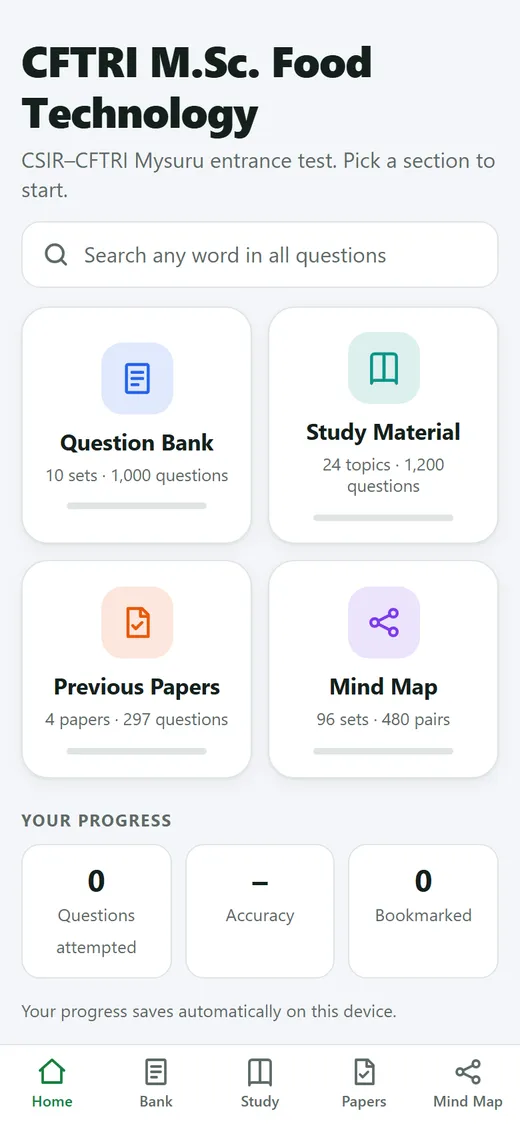
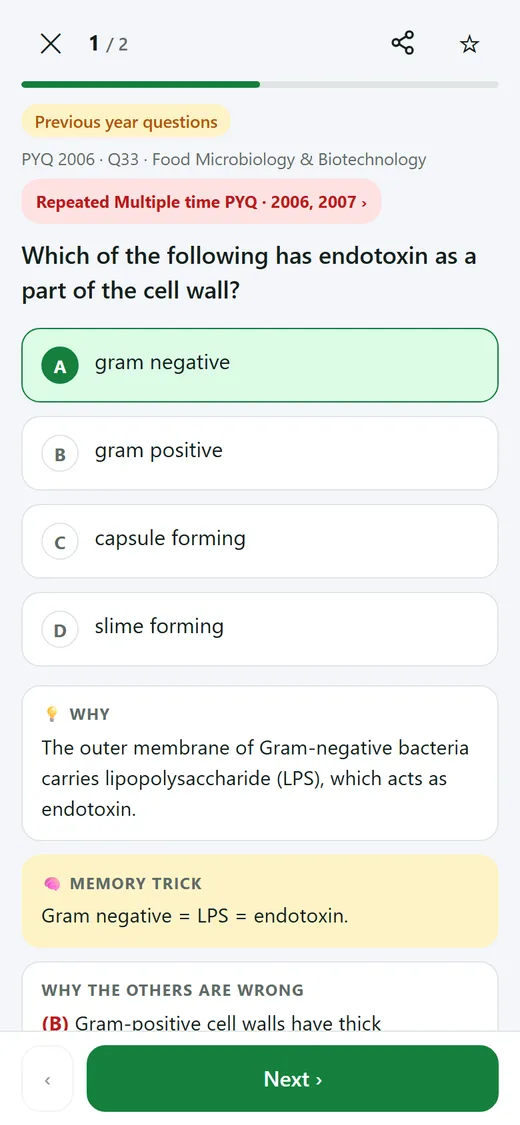
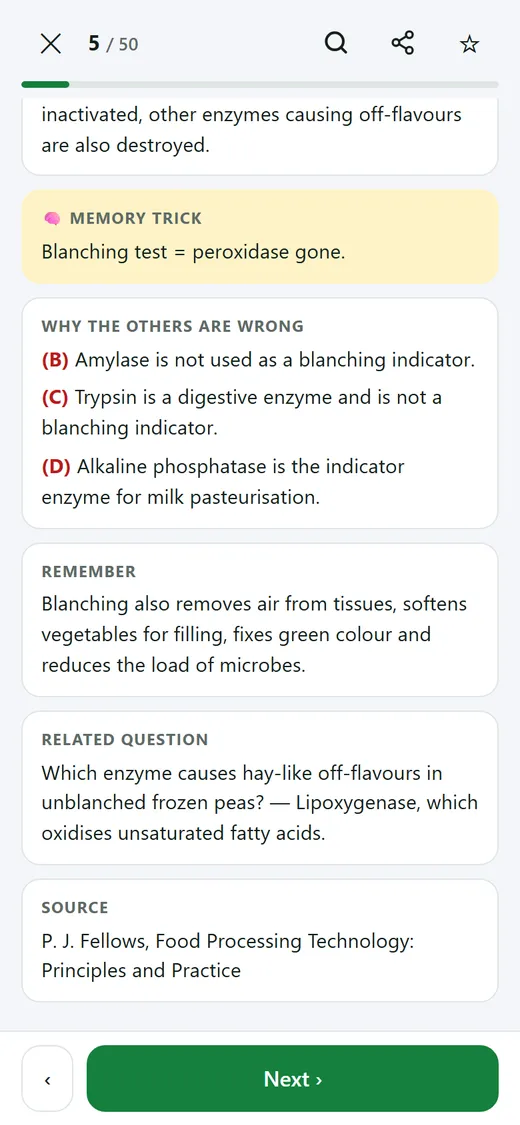
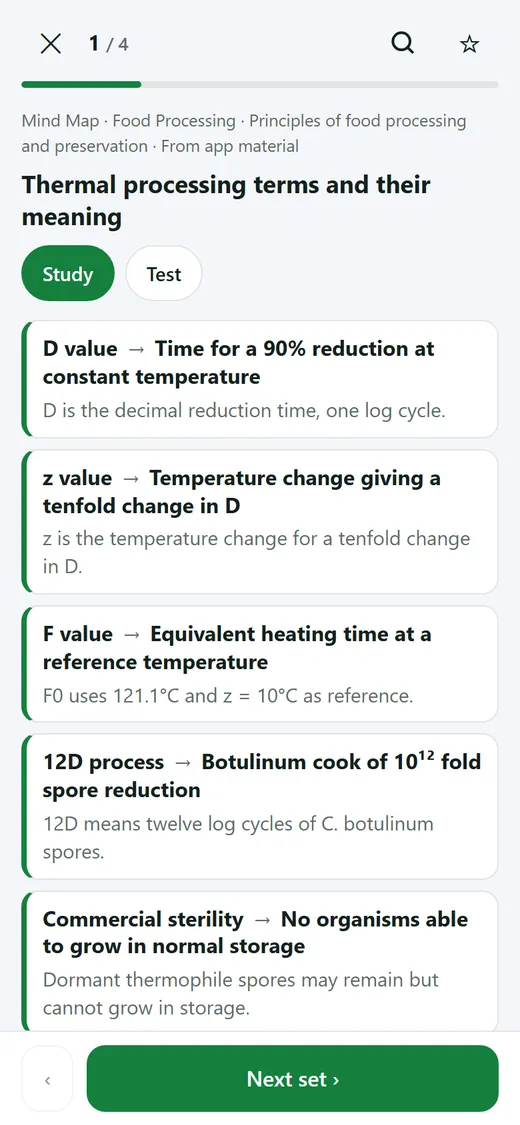
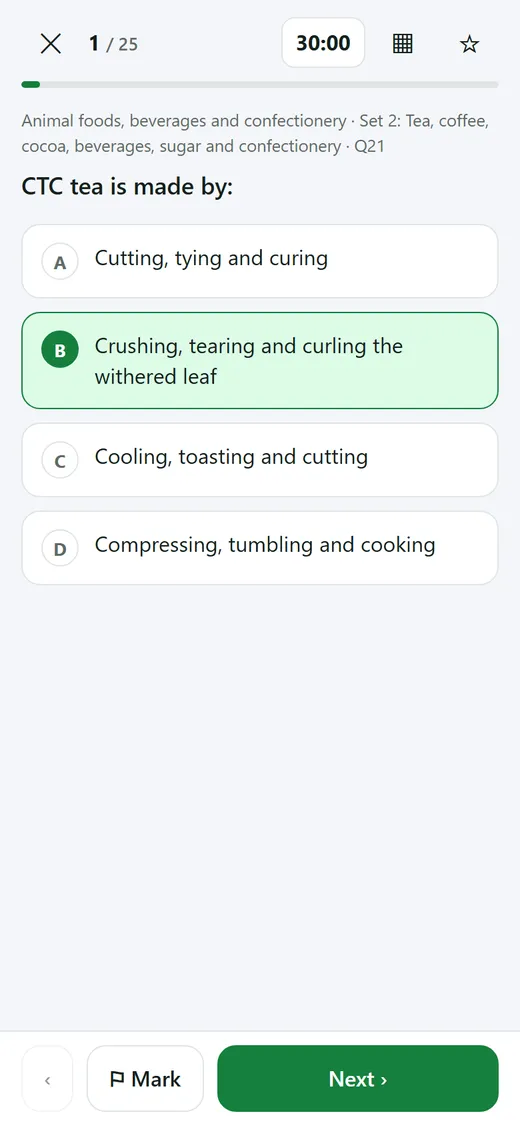
- All your practice in one appQuestion Bank, Study Material, Previous Papers and Mind Map, with your progress on every card.
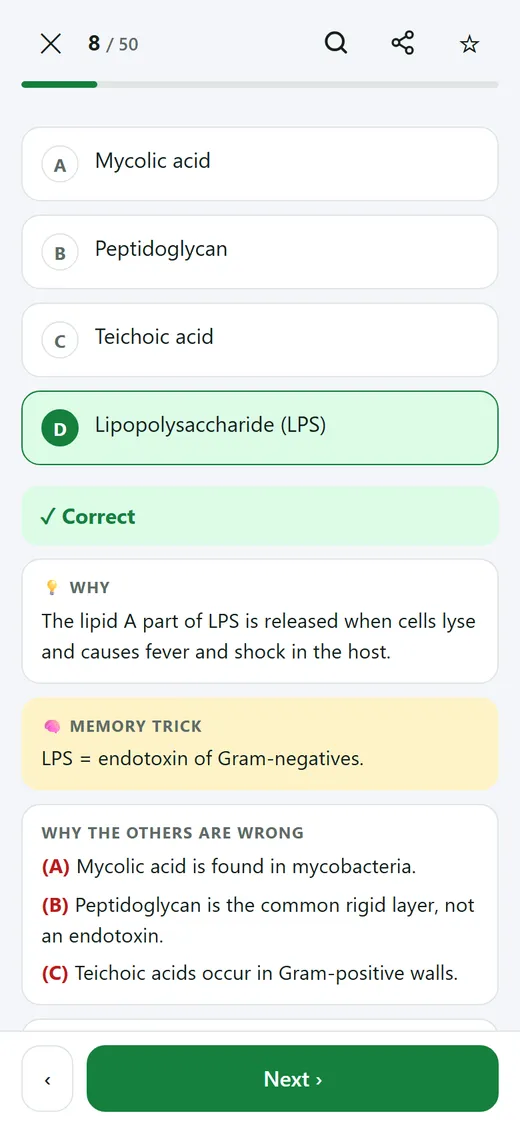
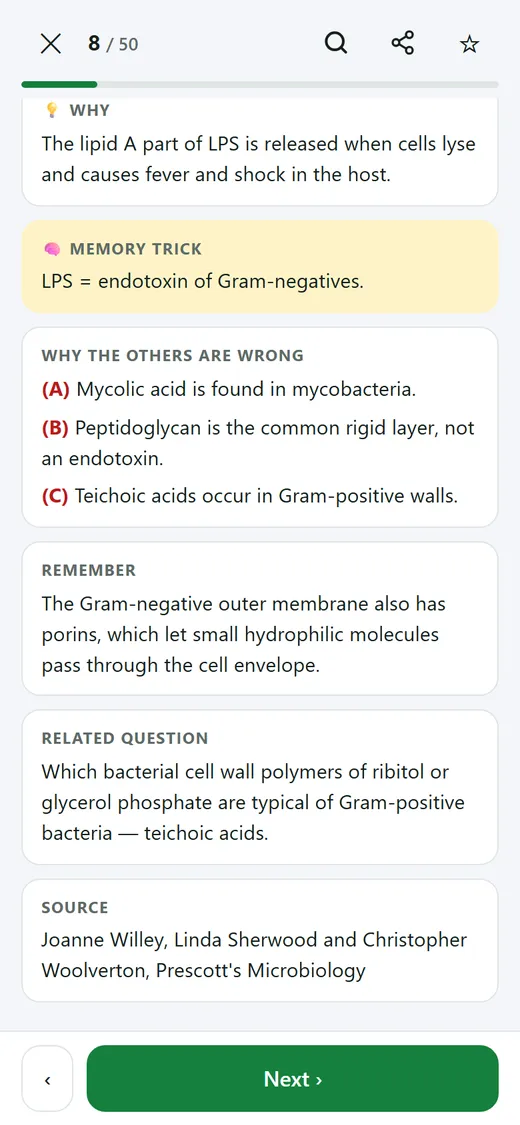
- A reason, a memory trick and why the others are wrongEvery answer explains itself, so one wrong guess teaches you three facts.
- Remember and Related questionA one-line fact to hold on to, and a connected question to test yourself next.
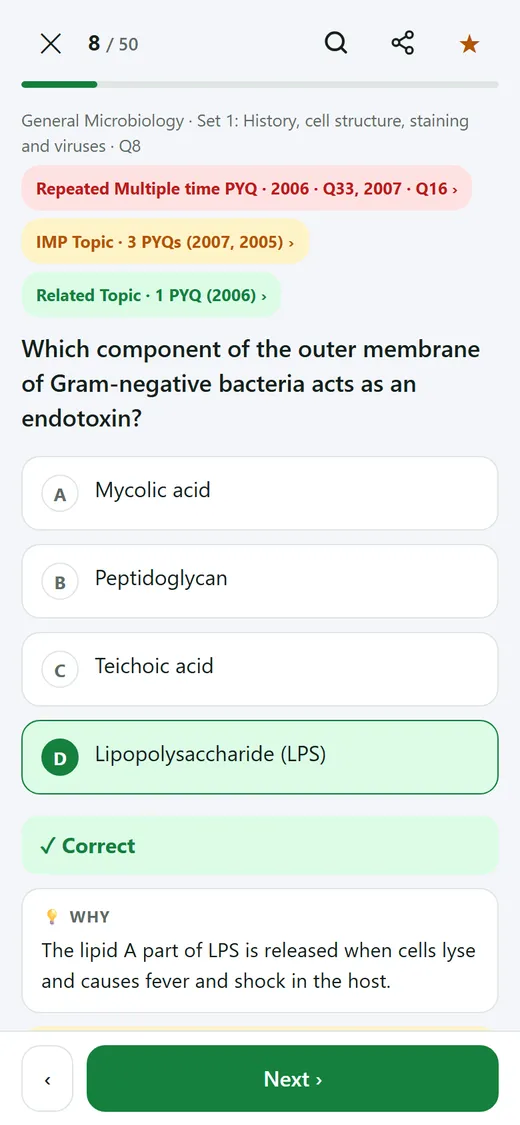
- PYQ, IMP Topic and Related Topic tagsSee at a glance if a fact was asked before, and bookmark the question with the star.
- Tap a tag to open the previous year questionThe original paper question opens right away, with its year and question number.
- Study Material MCQs name their sourceEach study question shows the book or document it comes from.
- Mind Map: match and learn pairsStudy the pairs, then test yourself. Pairs carry PYQ tags too.
- Timed mock test with a countdownPick the number of questions and the time, then practise like the real exam.
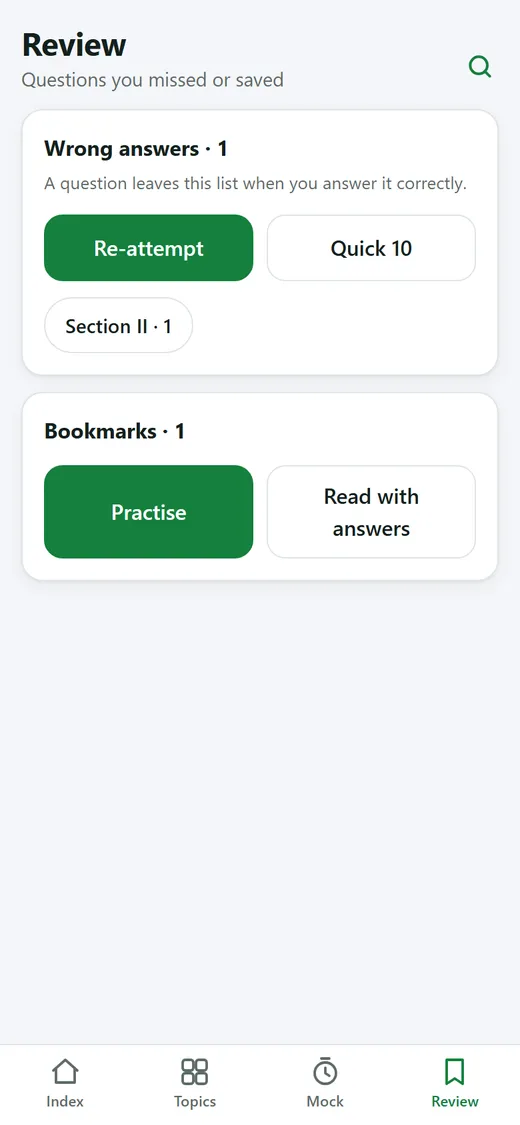
- Bookmarks and wrong answers in one placeRevise what you missed or saved, and re-attempt it in one tap.
What is inside
| Section | What you get | Size |
|---|---|---|
| CFTRI Question Bank | Sets of 100 questions spread over all eleven syllabus areas, from food processing and microbiology to physics, mathematics and mental ability. Sets 1 and 2 grew out of two full-length practice papers; Sets 3 to 10 are new | 1,000 questions · 10 sets |
| Study material MCQs | A question set for every syllabus topic, each naming the standard book or official document it comes from: food preservation and novel processing, plant and animal foods, packaging, additives and food law, general and food microbiology, fermentation and biotechnology, biomolecules, enzymes and metabolism, nutrition, chemistry, agriculture, dairy, food engineering, botany, zoology, physics, mathematics, reasoning and general awareness | 1,200 questions · 24 topics |
| Mind Map | Match column A with column B to revise related facts together: equipment and uses, vitamins and deficiency diseases, organisms and spoilage, enzymes and sources, units and quantities, SDGs and institutes | 96 sets · 480 pairs |
| Previous year papers | Four memory-based CFTRI entrance papers (2006, 2007, 2005 and 1998). CFTRI does not publish its question papers or an official answer key, so these papers were recalled by students and the answers were checked by MCQ Mitra against standard textbooks. Fill-in-the-blank questions were turned into four-option MCQs, and questions that cannot be answered with certainty are left out | 297 questions · 4 papers |
| PYQ tags | PYQ: the same fact was asked in a previous paper (with year and question number; "Repeated Multiple time PYQ" when it came in more than one year). IMP Topic: a previous paper asked about the same subject. Related Topic: a previous paper covered the same wider area. Tap any tag to open those previous year questions. The free trial shows tags too (locked when the questions are in the full version) | Question bank, study material and Mind Map |
| Sections | Practise by syllabus area: I Food Processing, II Food Microbiology and Biotechnology, III Biochemistry and Nutrition, IV Chemistry, V Agriculture and Dairy Technology, VI Food Engineering, VII Botany and Zoology, VIII Physics, IX Mathematics, X Mental Ability and XI General Awareness, in the question bank, study material, previous papers and Mind Map | 11 sections |
| Mock exams | Timed tests with negative marking (+1 / −¼ in the app, which you can switch off), a 120-minute default you can change, score by section and answer review. A mixed mock draws from all eleven areas | Unlimited |
| Search | Find any word in every question, option and explanation | All collections |
Syllabus covered (M.Sc. Food Technology entrance test)
- Food processing: thermal, non-thermal and novel processing, canning, freezing, drying, packaging, additives, HACCP, FSSAI and food standards
- Food microbiology and biotechnology: spoilage, food safety, fermentation, probiotics, recombinant DNA, CRISPR, GM foods
- Biochemistry and nutrition: biomolecules, enzymes, metabolism, vitamins, minerals, RDA, deficiency disorders, functional foods
- Chemistry, physics and mathematics at graduate level, with food chemistry and water activity
- Agriculture and dairy technology: crops, soils, milk, dairy products, adulteration
- Food engineering: fluid flow, heat transfer, unit operations, CIP and sanitation
- Botany and zoology, mental ability, and general awareness on health and wellness (static facts, no current affairs)
Sample questions
Tap an answer to see the explanation, memory trick, why the others are wrong, a fact to remember and a related question, just like in the app. All three are in the free trial.
Unlock the full app
One simple payment. No auto-debit, no hidden charges.
Loading plans…
Free trial includes
- 15 questions from the question bank
- One full previous year paper (CFTRI 2006, 82 questions) with its answers and explanations
- One study-material set (principles of food processing and preservation), 15 questions
- 3 Mind Map sets from Food Processing
- Mock exams, search and review on the trial questions
Where can I find CFTRI M.Sc. Food Technology entrance previous year question papers with answers?
CFTRI does not publish its question papers or an official answer key. The app has four memory-based CFTRI entrance papers (2006, 2007, 2005 and 1998), 297 questions with answers checked against standard textbooks, explanations and memory tricks. Fill-in-the-blank questions were turned into four-option MCQs, and questions that cannot be answered with certainty are left out. The full 2006 paper (82 questions) is free in the trial.
Is there a free CFTRI M.Sc. Food Technology mock test?
Yes. The free trial includes 15 questions from the question bank, the full 2006 paper (82 questions) with its answers and explanations, one study-material set (15 questions) and 3 Mind Map sets, with timed mock exams using negative marking (minus one quarter).
What does the CFTRI M.Sc. Food Technology syllabus cover in this app?
All eleven areas of the entrance syllabus: Food Processing, Food Microbiology and Biotechnology, Biochemistry and Nutrition, Chemistry, Agriculture and Dairy Technology, Food Engineering, Botany and Zoology, Physics, Mathematics, Mental Ability and General Awareness. Each has its own section, so you can practise one area at a time.
What is the exam pattern and marking scheme for the CFTRI M.Sc. Food Technology entrance test?
Mock exams in the app use +1 for a right answer, a quarter mark deducted for a wrong answer and 0 if skipped, with 100 questions in 120 minutes by default. These are the app settings, so please check the official CFTRI notification for the current pattern. You can switch negative marking off and choose a time from 30 to 150 minutes.
How many questions are in the CFTRI M.Sc. Food Technology app?
The full app has 2,497 questions: 1,000 question-bank MCQs in 10 sets of 100, 1,200 study-material MCQs in 24 topics, 297 previous year questions from 4 memory-based papers (2006, 2007, 2005 and 1998), and 96 Mind Map sets with 480 pairs.
What does each answer include in the CFTRI M.Sc. Food Technology app?
Every answer shows why it is right, a one-line memory trick, why each wrong option is wrong, a key fact to remember and a related question. Study-material questions also name the standard book or document they come from.
What are the PYQ, IMP Topic and Related Topic tags?
A PYQ tag means the same fact was asked in a previous CFTRI entrance paper. IMP Topic means a previous paper asked about the same subject, and Related Topic means a previous paper covered the same wider area. These tags appear on question-bank, study-material and Mind Map items. Tap a tag to open those previous year questions. The free trial shows these tags too; a tag that points to questions outside the trial is locked until you unlock the full version.
Does it include General Awareness or current affairs?
General Awareness is part of the CFTRI syllabus (SDGs, carbon footprint, circular economy, food labelling, quality management systems, vaccines and R&D institutions). The app covers it with static facts only, so there are no current-affairs or news questions.
Does the CFTRI M.Sc. Food Technology app work offline?
Yes. Once the app is open on your phone, tablet or computer it works without internet. With a paid plan it needs to go online for a few seconds at least once every 3 days to confirm your plan; the free trial works offline too.
How do I install the CFTRI M.Sc. Food Technology app on Android or iPhone?
Open the app link in Chrome on Android and choose Install app, or in Safari on iPhone tap Share and then Add to Home Screen. On a computer use the install button in Chrome or Edge. No Play Store or App Store is needed. See the install guide for steps.
Can I use one access code on more than one device?
One access code works on 2 devices, for example your phone and a laptop. While your plan is active, your answers, bookmarks and Mind Map results stay in step between them.
How much does the full CFTRI M.Sc. Food Technology app cost?
There are 6-month and 1-year plans, paid once by UPI, with the current prices shown under Plans on this page. There is no auto-debit, and you receive an access code on WhatsApp.
Is the CFTRI M.Sc. Food Technology app connected to CSIR-CFTRI?
MCQ Mitra is an independent practice tool. It is not connected to or approved by CSIR-CFTRI and does not guarantee exam results. The previous year papers are memory-based and have no official key.
Questions before buying?
Message us on WhatsApp. We usually reply the same day.